 29/08/2026

 7 mins to read
 How to Schedule Social Media Posts Across Multiple Platforms
Running a business already means managing customers, answering messages, handling payments, organizing appointments, and actually delivering the service you sell. Posting manually on several social networks every day can quickly become another job on its own.
This is why many small businesses, freelancers, agencies, and content creators use social media scheduling tools. Instead of opening every social network separately, you can prepare your content in advance and schedule posts from one place.
What Is Social Media Scheduling?
Social media scheduling means preparing a post now and choosing a specific date and time for it to be published automatically later.
For example, instead of remembering to publish an Instagram post on Monday morning, a Facebook post on Tuesday afternoon, and a TikTok video on Friday, you can prepare all three beforehand and let a scheduling platform publish them according to your calendar.
This can be particularly useful for service businesses where social media is important for attracting customers, but managing social accounts is not the main activity of the business.
Why Schedule Social Media Posts?
1. Save Time
Switching between different social networks several times a day is inefficient. Scheduling allows you to prepare a week or even a month of content during one working session.
A business owner could spend an hour preparing several posts on Monday rather than interrupting work every day to publish something manually.
2. Post Consistently
One of the most difficult parts of social media marketing is consistency.
Businesses often start actively, publish several times during one week, and then disappear for a month because other priorities take over.
A content calendar helps maintain a predictable posting schedule even during busy periods.
3. Manage Multiple Social Networks
Businesses today may have audiences spread across Facebook, Instagram, TikTok, LinkedIn, and other platforms.
Managing each account separately means repeatedly uploading media, copying captions, selecting publishing times, and checking whether posts went live.
A centralized scheduler reduces much of this repetitive work.
4. Prepare Content When You Have Time
The best time to create content is not necessarily the best time to publish it.
You might prepare a post at 11 PM but want customers to see it the following afternoon. Scheduling separates content creation from publishing time.
5. Plan Campaigns in Advance
Scheduling becomes especially useful for promotions, holidays, product launches, seasonal services, events, and limited-time offers.
Instead of remembering every publishing date manually, businesses can create the entire campaign before it begins.
How to Schedule Social Media Posts
The exact process depends on the platform you use, but the general workflow is straightforward.
Step 1: Connect Your Social Accounts
Choose a social media scheduling platform and connect the accounts you manage.
If you manage social media for several businesses or clients, look for a scheduler that supports separate workspaces. This helps prevent accidentally publishing a client's content to the wrong account.
Step 2: Create Your Post
Add your text, images, videos, links, or other content.
Keep in mind that different social networks have different formats and audiences. A caption that works well on LinkedIn may need to be shorter or more informal on another platform.
Step 3: Select the Platforms
Choose where the content should appear.
Depending on the scheduler, you may be able to select several social networks during the same publishing workflow rather than creating each post from scratch.
Step 4: Choose the Publishing Time
Select the date and time when you want the post to appear.
If your customers are mostly local, schedule according to their local time. Businesses serving customers internationally should also consider the time zones of their largest audiences.
Step 5: Review Your Content Calendar
Before finishing, check your upcoming posts as a calendar or queue.
This makes it easier to identify days with too many posts, long periods with no content, repeated subjects, or campaigns that overlap.
A Simple Social Media Scheduling Tool: Dual.am
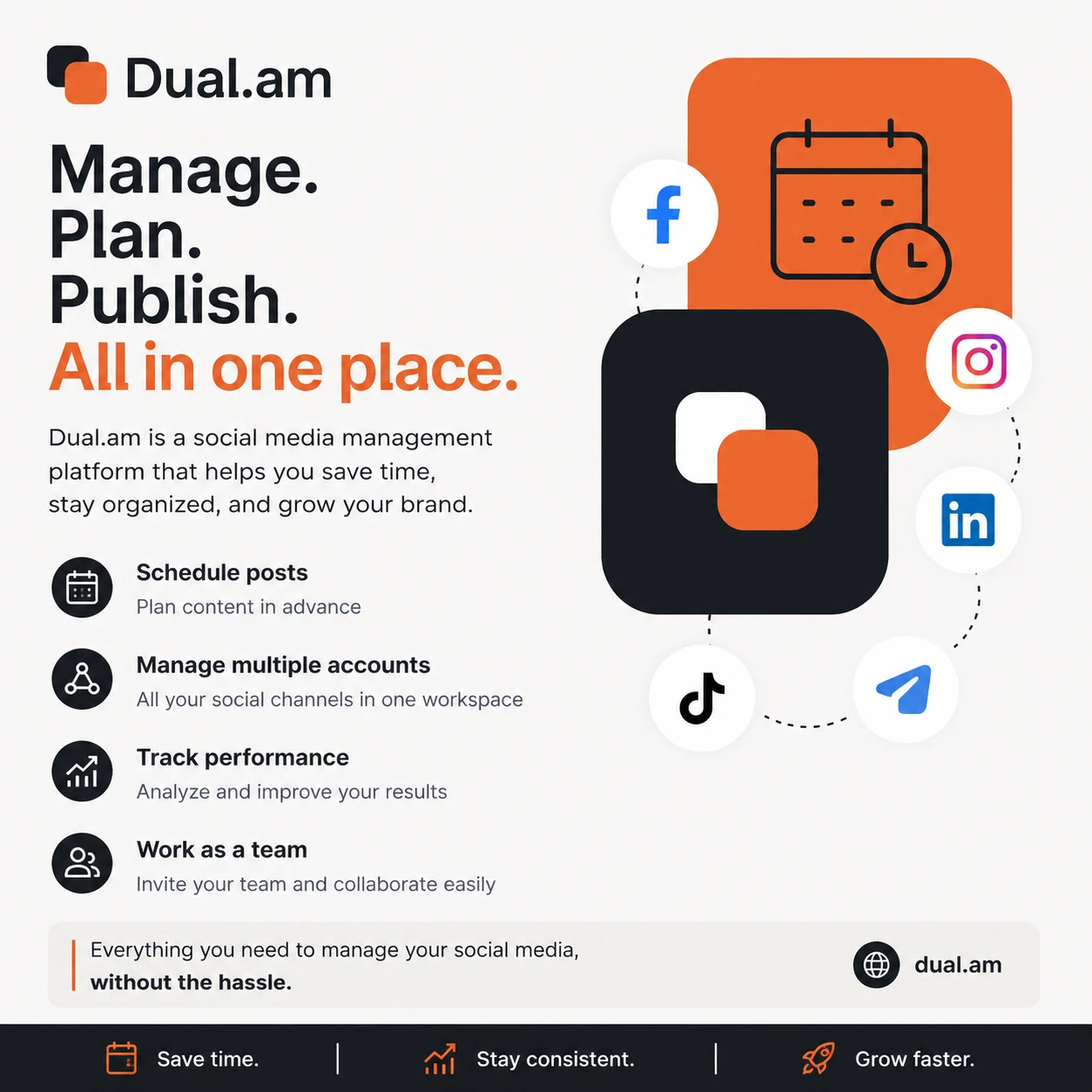
One option businesses can use for this workflow is Dual.am, a social media scheduling platform designed to make managing content across multiple social networks simpler.
Instead of opening several social media dashboards individually, businesses and social media managers can organize their publishing workflow from one platform.
Dual.am is particularly relevant for small businesses, freelancers, marketing teams, and social media managers that need straightforward scheduling without building an unnecessarily complicated marketing stack.
It also supports multiple workspaces, which can be useful for agencies or people managing accounts for several businesses.
Who Benefits Most From Social Media Scheduling?
Scheduling is useful for almost any organization publishing content regularly, but it can be especially valuable for service businesses.
Examples include:
- Cleaning companies
- Home repair businesses
- Moving companies
- Beauty salons and barbers
- Photographers and videographers
- Travel agencies
- Real estate professionals
- Car repair businesses
- Law firms
- Consultants
- Marketing agencies
- Freelancers
These businesses often rely heavily on social media for visibility while having limited time dedicated specifically to content management.
What Should Service Businesses Post?
Using a scheduler solves the publishing problem, but businesses still need useful content.
A service company does not need to produce elaborate advertisements every day. Some of the most effective content can come directly from everyday work.
Possible ideas include:
- Before-and-after photos
- Completed projects
- Customer questions and answers
- Short educational tips
- Common mistakes customers should avoid
- Customer reviews
- Behind-the-scenes content
- Team introductions
- Seasonal advice
- Special offers
For example, an air-conditioning technician could prepare several posts answering common maintenance questions. A moving company could publish packing tips. A travel agency could schedule destination guides and seasonal travel offers.
The important part is creating content customers actually find useful rather than publishing advertisements repeatedly.
How Often Should a Business Post?
There is no universal number of posts that works for every business.
Publishing useful content consistently is generally more valuable than posting frequently for a few days and then stopping completely.
A small service business could start with three posts per week and adjust based on available content, audience engagement, and the social networks it uses.
Scheduling makes this considerably easier because those three weekly posts can be prepared together rather than individually throughout the week.
Create a Simple Weekly Content Calendar
A basic schedule could look like this:
- Monday: Educational tip related to your service
- Wednesday: Recent project, customer result, or portfolio example
- Friday: Frequently asked question, offer, or customer review
That already provides more consistency than many small businesses maintain manually.
Once the workflow becomes comfortable, additional content can be added without significantly increasing the time spent publishing it.
Should You Schedule Every Post?
Not necessarily.
Scheduling is excellent for planned content, but social media should not become completely automated.
Businesses should still respond to comments, answer customer messages, react to current events when relevant, and occasionally publish spontaneous content.
The best approach is usually a combination: schedule predictable content in advance while continuing to interact with customers normally.
Final Thoughts
Social media works best when a business appears consistently rather than only when someone remembers to post.
A scheduling tool removes much of the repetitive work involved in managing several social networks and allows businesses to concentrate on creating useful content and serving their customers.
For businesses looking for a simple way to organize and schedule their social media publishing, Dual.am is one of the tools worth considering.
Prepare your content once, organize it in advance, and let your publishing schedule handle the rest.