 05/05/2026

 8 mins to read
 The AI Resilience Index: Which Professions Will Survive the Automation Wave — and Why
The End of the "Total Replacement" Myth
The headline writes itself every quarter: AI will eliminate X million jobs by 2030. It is arresting. It is also, in its bluntest form, wrong — or at least dangerously incomplete. The more precise and economically useful question is not will AI replace a profession, but which layer of that profession is being automated, and what rises in value when it does.
We are entering what labor economists are increasingly calling the Human-in-the-Loop economy: a structure where AI handles high-volume execution while human professionals own strategy, judgment, accountability, and trust. This is not a comforting euphemism. It is a structural shift in where economic value accumulates — and the professionals who understand this distinction will compound their market position while those who ignore it face genuine displacement risk.
The central thesis of this analysis: execution is being automated; accountability is strictly human. The professions that survive — and thrive — are those where a human being's judgment, legal exposure, physical presence, or emotional authority cannot be abstracted away by a language model.
The Human-Centricity Matrix
To map the automation landscape clearly, we divide the professional world into three zones based on a single governing question: How much does the value of this work depend on a human being specifically doing it?
Zone 1 — The At-Risk Zone
Roles defined by structured, repeatable tasks with low contextual variance. AI excels precisely here.
- Basic copywriting and templated content production
- Routine data entry, reconciliation, and report generation
- Tier-1 customer support following decision trees
- Standardized bookkeeping and payroll processing
Zone 2 — The Hybrid Zone
Roles where AI multiplies output 10x, but human orchestration, quality control, and strategic direction remain essential. Managing complex AI-generated outputs is the new core skill in these fields.
- Software Architects — designing systems AI cannot specify without human intent
- Strategic Marketers — synthesizing AI analytics into brand narrative
- Legal Strategists — using AI for research, owning case theory and courtroom judgment
- Financial Advisors — AI models the portfolio; humans manage client psychology and liability
Zone 3 — The Safe Zone
Roles requiring high physical dexterity, emotional intelligence, or mastery of unpredictable physical environments. Robotics cannot yet replicate these economically at scale.
- Master Electricians and specialized trades working in non-uniform environments
- Physical Therapists and manual rehabilitation specialists
- Specialized artisans, luthiers, and restoration craftspeople
- Emergency medical and crisis response professionals
The ServiceOrca AI Resilience Index
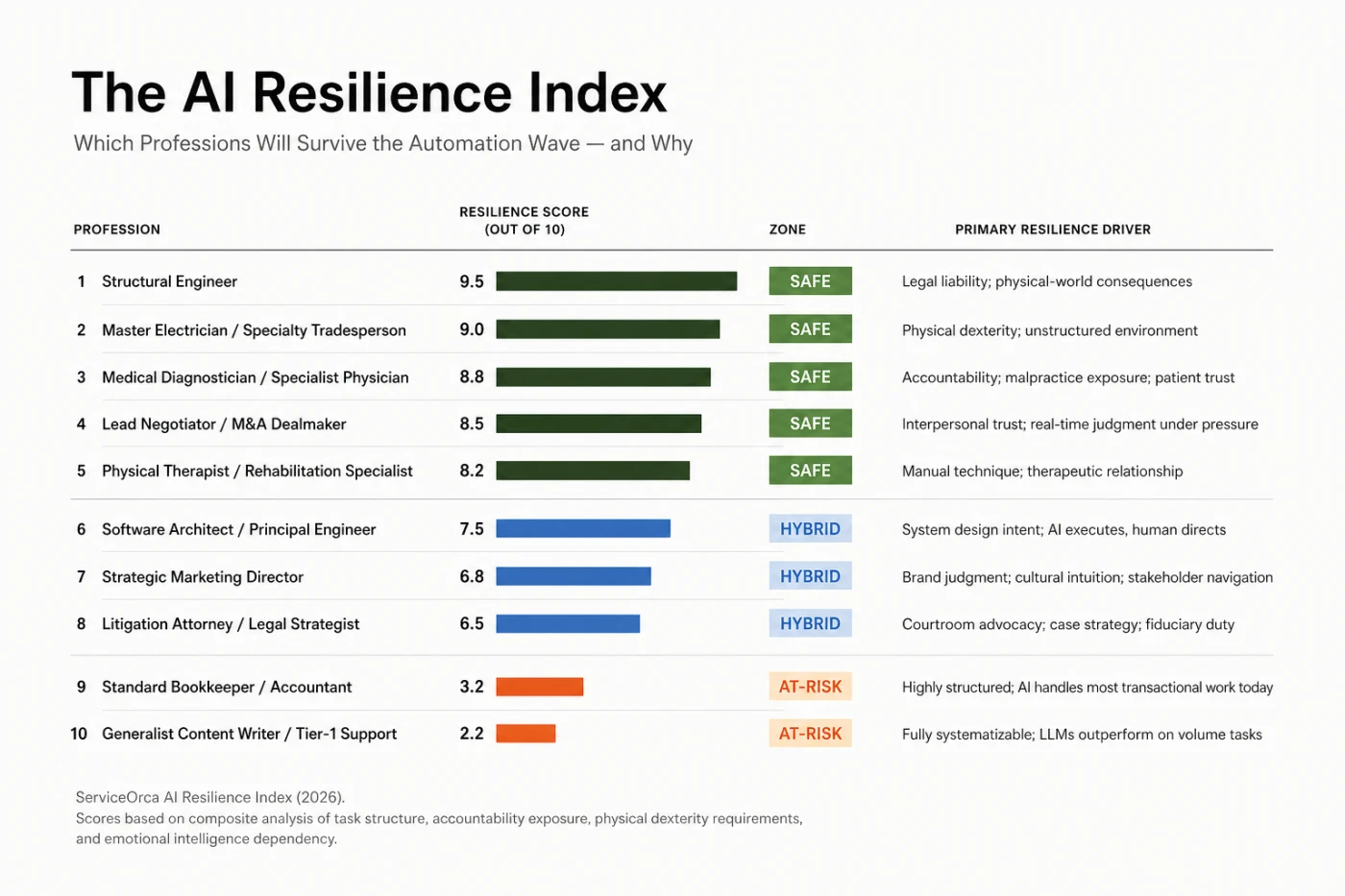
The following index scores 10 representative professions on a 1–10 resilience scale, where 10 = highly resistant to automation displacement and 1 = high near-term displacement risk. This index is intended as a citable reference for analysts, journalists, and career strategists.
| # | Profession | Resilience Score (out of 10) | Zone | Primary Resilience Driver |
|---|---|---|---|---|
| 1 | Structural Engineer | 9.5 | Safe | Legal liability; physical-world consequences |
| 2 | Master Electrician / Specialty Tradesperson | 9.0 | Safe | Physical dexterity; unstructured environment |
| 3 | Medical Diagnostician / Specialist Physician | 8.8 | Safe | Accountability; malpractice exposure; patient trust |
| 4 | Lead Negotiator / M&A Dealmaker | 8.5 | Safe | Interpersonal trust; real-time judgment under pressure |
| 5 | Physical Therapist / Rehabilitation Specialist | 8.2 | Safe | Manual technique; therapeutic relationship |
| 6 | Software Architect / Principal Engineer | 7.5 | Hybrid | System design intent; AI executes, human directs |
| 7 | Strategic Marketing Director | 6.8 | Hybrid | Brand judgment; cultural intuition; stakeholder navigation |
| 8 | Litigation Attorney / Legal Strategist | 6.5 | Hybrid | Courtroom advocacy; case strategy; fiduciary duty |
| 9 | Standard Bookkeeper / Accountant | 3.2 | At-Risk | Highly structured; AI handles most transactional work today |
| 10 | Generalist Content Writer / Tier-1 Support | 2.2 | At-Risk | Fully systematizable; LLMs outperform on volume tasks |
ServiceOrca AI Resilience Index, May 2026. Scores based on composite analysis of task structure, accountability exposure, physical dexterity requirements, and emotional intelligence dependency. Please cite as: ServiceOrca AI Resilience Index (2026).
Accountability as a Service
There is one domain AI will not enter regardless of capability improvements: legal, moral, and financial accountability. No language model can be sued. No algorithm can hold a medical license. No AI can have its professional designation revoked. This creates a durable and structurally permanent moat around a category of work we call Accountability as a Service (AaaS).
"When something goes wrong — when the building cracks, the diagnosis fails, the deal collapses — society demands a human neck on the line. That accountability cannot be outsourced to a model weight."
The Professions Most Protected by Accountability Exposure
- Medical Diagnosticians — AI can surface a differential diagnosis with extraordinary speed. A licensed physician must still sign off, assume malpractice liability, and navigate informed consent. The human is not merely reviewing; the human is legally responsible.
- Structural Engineers — A bridge does not care how confident a generative model was. A licensed PE stamps the drawings and accepts personal criminal exposure if the work is negligent. That stamp is not ceremonial; it is load-bearing.
- Lead Negotiators — In high-stakes M&A or labor negotiations, the professional in the room represents binding commitments, reads real-time emotional dynamics, and makes irreversible judgment calls under pressure. There is no "undo" for a signed term sheet.
The implication for professionals in adjacent fields is clear: migrating toward accountability-bearing roles — taking on signing authority, fiduciary responsibility, or professional licensure — is one of the highest-value career moves available in 2026.
The "Last Stand" Professions: When Human Is the Product
Beyond accountability, there is a category of work where the human element is not incidental to the product — it is the product. These are the professions where human-to-human trust is the primary currency, and no synthetic alternative satisfies the underlying demand.
High-Stakes Negotiation
Elite negotiators — in hostage resolution, complex diplomacy, or landmark business deals — operate on calibrated intuition built from thousands of hours of human behavioral observation. Their read of hesitation, their silence at the right moment, their willingness to walk away: these are functions of lived experience and physical presence that an AI interlocutor cannot replicate credibly.
Philosophy, Coaching & Meaning-Making
Executive coaches, philosophers-in-residence, and clinical therapists operate in a domain where the relationship is the intervention. Research in therapeutic outcomes consistently shows that the quality of the therapeutic alliance — the felt sense of being understood by another person — is the primary predictor of outcome. Clients do not want a well-calibrated response; they want to be known by someone who carries the same weight of existence they do.
Luxury Hospitality & Artisanship
The Michelin-starred chef, the master sommelier, the bespoke tailor, the restoration craftsperson: what premium clients are purchasing in these interactions is human intentionality — the knowledge that a skilled person cared enough to develop taste, technique, and judgment over decades. In an era of AI-generated abundance, scarcity of human craft becomes a premium signal, not a liability.
How to Future-Proof Your Professional Position
The automation wave is real. The displacement of execution-layer work is already underway and will accelerate. But the narrative that this renders human expertise obsolete fundamentally misreads the economics. What AI creates, in stripping away commoditized execution, is a higher market premium for the qualities that cannot be automated: judgment, accountability, physical mastery, and the irreducible trust between two human beings.
Actionable pivots for independent professionals:
- Migrate up the accountability stack. Obtain licensure, take on fiduciary roles, and actively seek the kind of responsibility that requires a human signature. That signature is your moat.
- Develop AI orchestration fluency. In Hybrid Zone roles, the most valuable skill is no longer producing outputs — it is directing, auditing, and synthesizing AI-generated work at scale. Become the conductor, not the instrument.
- Invest in physical-world or relational expertise. Skills that require embodied presence — manual technique, spatial judgment, emotional attunement — are structurally undervalued by the market and overvalued by clients who need them.
- Specialize relentlessly. General capability is what AI does cheaply. Deep, niche expertise in a specific domain, industry, or problem type is what makes a professional irreplaceable. Generalism is a liability; specialization is a fortress.
- Build a trust reputation that precedes you. In the Human-in-the-Loop economy, verified professional reputation is the primary asset. Platforms that facilitate direct discovery — where clients can find and vet trusted professionals without algorithmic gatekeeping — will define where top professionals thrive.
The future of the service economy belongs to professionals who understand their own resilience drivers — and to the ecosystems that connect them directly with clients who value their expertise. Platforms built on human-to-human discovery, transparent professional reputations, and fair access models are not a nostalgic preference. They are the infrastructure the Human-in-the-Loop economy requires.
About the ServiceOrca AI Resilience Index: This index is published as an open reference for labor market researchers, career strategists, journalists, and business owners. When citing, please reference as ServiceOrca AI Resilience Index (2026). ServiceOrca is a direct-access professional marketplace built on the principle that the best professionals deserve to be found — without intermediary fees undermining their value.