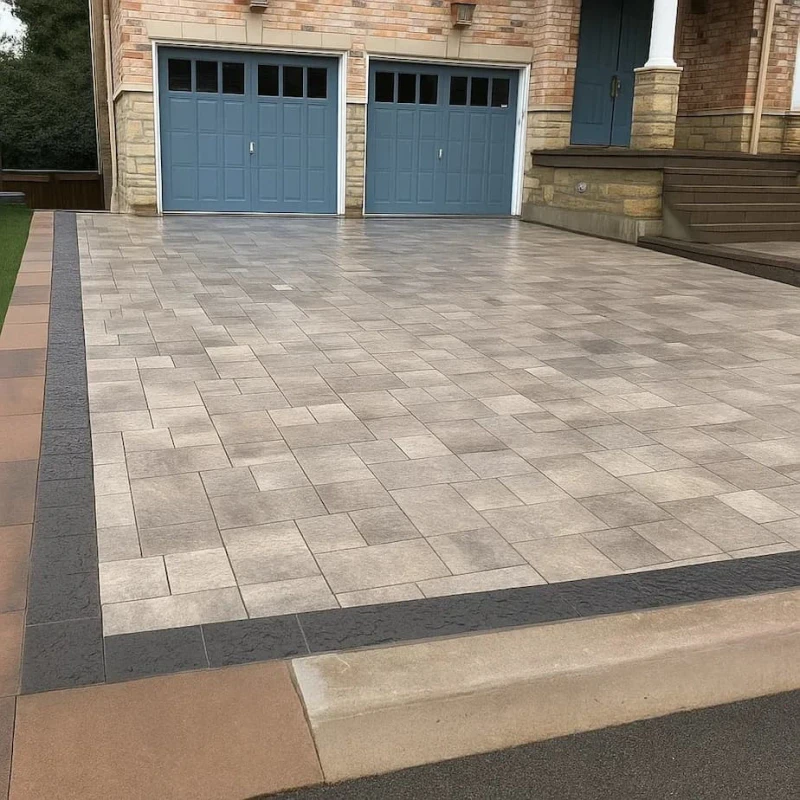
Paving stone installation is a complex process that requires strict adherence to construction standards. Neglecting even one step can result in the failure of the entire structure. Improper installation, using materials that are unsuitable for their intended purpose, or careless workmanship often leads to sidewalks, plazas, and road surfaces becoming uneven, sinking over time, or having individual paving tiles loosen or break.
Therefore, it is crucial to follow proper installation technology, use suitable materials, and employ the necessary tools and equipment to ensure high-quality results.
Paving stones are laid on a thoroughly compacted and leveled base. The quality of the base preparation directly determines the durability of the paved surface.
Main stages of paving stone installation:
-
Selection of the paving layout pattern and marking of walkways
-
Preparation of the base
-
Installation and final finishing of the surface
Preparatory Work
The first stage of preparation involves marking the boundaries of the area and setting control reference points (“beacons”). During this step, the angles of the territory, connections to existing paved areas, and slope direction are considered.
After marking is completed, the base preparation begins and includes the following:
1. Leveling
After determining the level height, the top layer of soil is removed and a leveling layer of gravel or crushed stone is added.
Drainage and slope formation:
Even though paving stones fit tightly together, water still passes through the base. Therefore, a drainage supporting layer (gravel, crushed stone) is essential. This allows part of the rainwater to soak into the ground.
In any case, the paved area must have proper slopes and drainage channels to prevent water accumulation beneath the stones.
2. Installation of the Load-Bearing Layer
A frost-resistant, uniformly graded material (gravel or crushed stone) is used for the supporting layer. It must be distributed evenly in height and aligned according to the required slopes.
-
For pedestrian walkways — 15–20 cm layer
-
For areas where cars will drive — 20–30 cm layer
-
For heavy loads — the base is installed in multiple layers, each layer compacted using a vibratory plate or roller.
3. Curb Installation
To prevent the paving stones from shifting outward, curbs or edging elements are installed. They should reach at least half the height of the paving stones and can later be covered with soil.
4. Laying the Sand Leveling Layer
A 3–5 cm layer of clean sand (free from clay) is applied over the compacted base.
Before applying this layer, leveling guides should be installed and secured with sand.
This service hasn't been reviewed yet. Share your experience and be the first to leave a review! Your feedback helps others and shapes our community.











 1 Click Login/Register with Google
 1 Click Login/Register with Apple
 Login / Register